EV battery state of health (SoH) for fleets: how to monitor it and protect residual value
Oct 28, 2026 · 5 min read · update
EV battery state of health (SoH) is the share of its original usable capacity that a battery still holds, shown as a percentage. For fleet operators and leasing companies, it is one of the biggest drivers of an EV's residual value, and one of the hardest things to see between the day a vehicle is delivered and the day it comes back.
Volteum now shows battery SoH for every connected EV in your fleet, taken from the vehicle's own data, with no hardware to fit. Here is why it matters and how it works.
What is EV battery state of health?
SoH compares what a battery can do today with what it could do when new. A battery at 90% SoH holds about 90% of its original usable capacity. Battery degradation is the gradual loss of that capacity, and SoH is how you measure it.
It is not the same as state of charge (SoC), which shows how full the battery is right now. SoC changes every day. SoH moves slowly, over years.
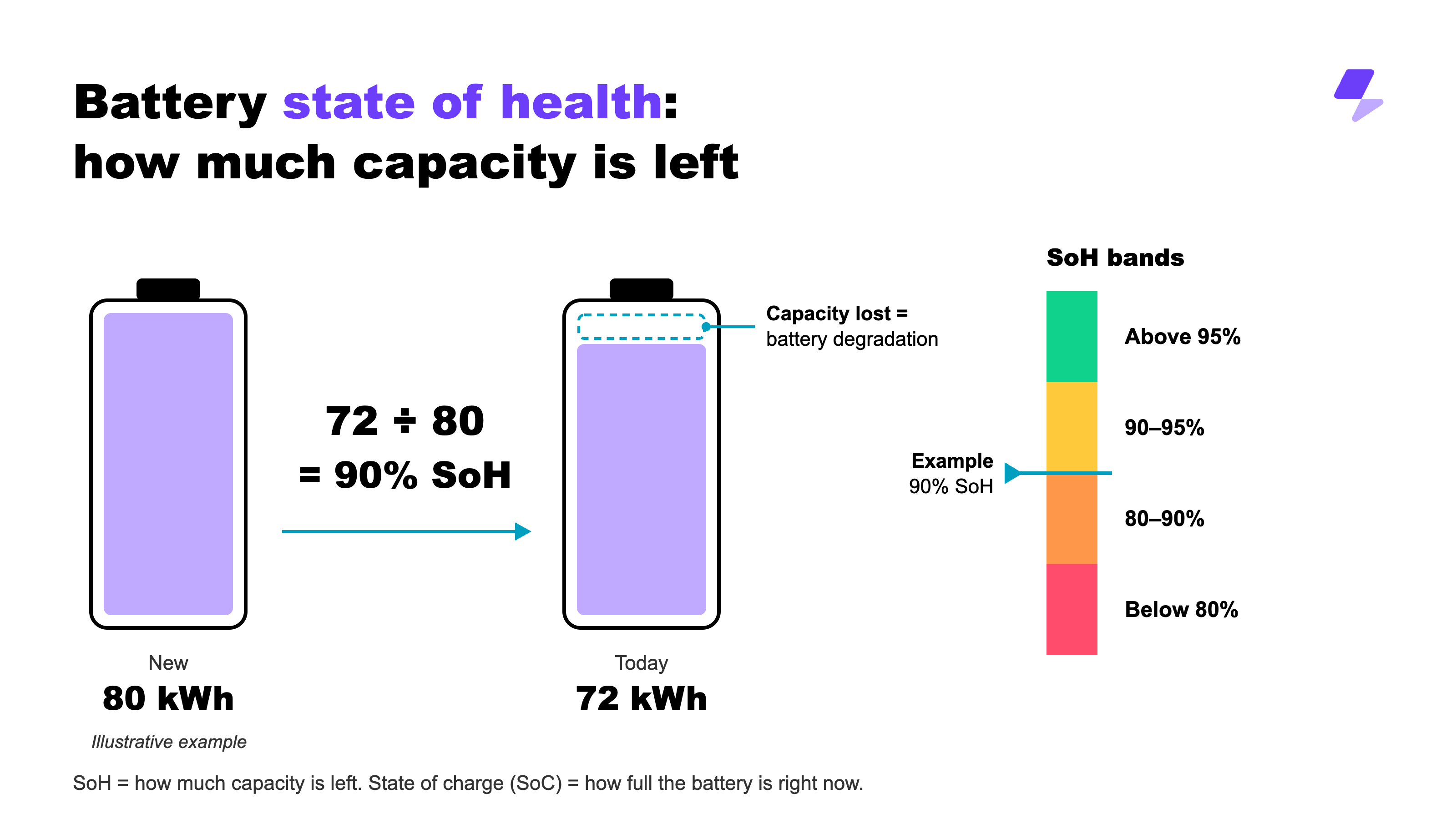
Battery degradation is the gradual loss of capacity. SoH shows how much is left. (Illustrative example.)
Why battery SoH matters for fleets and leasing companies
The battery is the most expensive component in an EV, so its condition feeds directly into what the vehicle is worth at the end of a contract.
Buyers want proof of that condition. BCA, Europe's largest car remarketer, found that EVs sold with a battery certificate achieved around 1.4% higher resale value and sold 2.7 days faster on average. Arval has issued more than 30,000 battery health certificates across the UK and EU.
The data on battery degradation is also reassuring. Arval's analysis of 8,300 EVs found an average SoH of 93% at 70,000 km, and close to 90% beyond 200,000 km. A UK study of more than 8,000 cars by Generational put the average at around 95%.
So the problem is rarely that batteries fail. The problem is that most fleets cannot evidence the condition of the ones they have.
The visibility gap
- SoH is usually checked at inspection or on return, not tracked across the contract.
- Hardware telematics adds cost, fitting downtime and potential warranty concerns on vehicles you own or finance.
- Location-based tracking raises driver and GDPR concerns, especially on private-use vehicles.
How Volteum tracks battery state of health
Volteum connects to vehicle manufacturers' data platforms through certified APIs. You share a VIN list, and the fleet is typically live within days. No devices, no fitting visits, no SIM cards.
Once connected, SoH sits in the same platform as mileage, charging, faults and maintenance:
- A colour-coded SoH badge per vehicle: green above 95%, yellow 90 to 95%, orange 80 to 90%, red below 80%.
- SoH history per vehicle: track battery degradation over time and see which vehicles degrade faster than expected.
- No GPS required: location data can be excluded entirely.
- Mixed fleets: diesel, petrol and hybrid vehicles sit in the same view, with their mileage, fault and maintenance data.
SoH availability depends on the manufacturer, model and country, so we check coverage against your VIN list before you commit.
.png)
The battery health page in Volteum: average SoH, vehicles by SoH band, and decline rate per vehicle. (Demo data.)
How leasing companies and fleet operators use SoH data
Leasing companies
- Evidence of battery condition at contract end, instead of assumptions.
- A documented battery history to support remarketing.
- All client vehicles in one platform, segmented per client.
Fleet operators
- Spot vehicles that are degrading faster than the rest and act early.
- Combine SoH with charging analytics: Volteum flags vehicles with high DC fast-charging use, which is harder on the battery, so you can address charging habits.
- Base replacement and contract-extension decisions on real data.
Battery health certificates and what comes next
A certificate is a snapshot at the point of sale. Continuous monitoring gives you the history behind it, from delivery to return.
UK industry bodies have called for standardised battery health information on used EVs, and the EU Battery Regulation introduces battery passports for EVs from February 2027. Fleets that already hold continuous SoH data will find those requirements easier to meet.
FAQ
What is a good state of health for an EV battery?
According to Arval's analysis of 8,300 EVs, the average is around 93% at 70,000 km and close to 90% beyond 200,000 km. Individual vehicles vary with usage, charging habits and temperature.
What is the difference between SoH and state of charge?
State of charge shows how full the battery is at a given moment. State of health shows how much of its original capacity the battery can still hold.
Can I monitor EV battery health without installing hardware?
Yes, where the manufacturer provides the data. Volteum reads it through OEM APIs from a VIN list, so nothing is fitted to the vehicle.
Do I need location tracking to see battery health?
No. SoH, mileage, faults and charging data are available without GPS.